
On this page
Make room for the next choice.
As the Narateer Guide, you bring a situation to the table and discover what the players do with it. You describe the world, play its other inhabitants and help everyone follow the consequences. You can begin with one place, a few people and a problem worth acting on.
This chapter helps you bring a group together, prepare an adventure and keep play moving. The linked chapters own the game procedures. Use this advice to find the next useful question, prepare what you need and share the work.
Bring a Group Together
Invite people to a specific first game. Tell them where you will play, when it starts, how long it will last and what they need to bring. Say whether newcomers are welcome and whether you will make characters together. Friends, a local games group or an online community can be a starting point.
Give the invitation a small, clear promise:
“A three-and-a-half-hour Narateer adventure, Saturday afternoon. New players welcome. We'll play travellers helping a settlement beside a broken World Tree root. Expect exploration, strange discoveries and choices about whom to trust. I'll help with characters.”
Start with a short adventure so everyone can try the game and the group. Afterwards, ask whether they want to continue. If they do, build the campaign from the people, places and unfinished business that interested them.
Choose one place for arrangements and reminders. Agree how to report an absence, whether a smaller group will still meet, and what happens to an absent player's character. Get that player's agreement before someone else makes consequential choices for their character.
Agree on the Adventure
Before the first session, hold a Session Zero. Agree on the kind of adventure, boundaries and access needs. Give people a way to raise a concern privately too. Follow that chapter's safety tools during play.
Ask each player for one thing their character wants and one reason to work with the others. Use those answers to connect the group to the opening problem. A shared purpose gives players something to pursue while leaving room for their own choices.
Settle practical questions together: session length, breaks, food, online arrangements and how often you hope to meet. Ask what help would make the game easier to follow. A player may prefer a written recap, clear turn reminders or help finding a rule.
Prepare a Situation
For a first adventure, prepare one place and a problem the characters can change. A settlement's water is failing. A ferry keeper has vanished. Two groups claim the same sacred relic. Choose something that invites several possible approaches.
Write a few notes you can use during play:
- The immediate problem: what is happening, and why does it matter now?
- The people involved: what does each want, what do they know and what might persuade them?
- The useful places: what can the characters notice, reach or investigate there?
- The pressure: what might change if nobody intervenes?
- The possible approaches: where could talking, exploration, ingenuity or force help?
Prepare consequences for likely choices, then leave room for other approaches. If the players help someone you expected them to oppose, use that person's wants to decide how they respond.
For a discovery that matters, prepare more than one possible lead. Decide which facts are plainly available and which attempts contain meaningful uncertainty. Skill Checks explains when to roll and how to establish the stakes. A failed attempt can change the situation; it need not erase every other lead.
People and Creatures
The people your players meet don't need to be built like player characters. An NPC can skip Bloodline, Origin and Class. Give it the Core Vitals, Skills, gear and a few traits the situation needs, and nothing more. A street sweeper might have Athletics 1 and nothing else. Add a Bloodline, its traits or a Class only when they matter to who this person is.
For speed, start from a ready-made Profile at Guide’s Table, then rename and reshape it. For animals and beasts, use the Bestiary.
A Three-and-a-Half-Hour Session
This is a planning example. Adjust it to your group and follow choices that earn attention.
| Time | What you might prepare |
|---|---|
| 15 minutes | Welcome, recap, character aims and a clear opening decision. |
| 45 minutes | First conversations, exploration and leads. |
| 10 minutes | A break and a chance to ask questions. |
| 75 minutes | The main problem: a negotiation, investigation, hazard, fight or mixture. |
| 55 minutes | Consequences, another meaningful choice or a changed situation. |
| 10 minutes | Record the state, recap and arrange the next session. |
Keep an optional complication ready if the group moves quickly. If time is short, end at a clear decision or an agreed stopping point. You can carry an unresolved problem into the next session. Real session time does not itself advance a character's recovery clock or end an effect.
Plan with Adventure Loom
A session moves through a series of Scenes, each with its own Kind and Mode. The upcoming Guide's Table will help you run them.
Adventure Loom can hold your preparation as connected Cards. Begin with Blank canvas, try Guided foundation, or choose a structure from the Template library.
Make Cards for the important places, people, discoveries and problems. Connect them with labelled Threads showing possible leads or relationships. For the missing ferry keeper, you might connect the landing to a witness, a damaged boat and a path into the marsh. Each gives the players a different way to begin.
Use the Run Sheet to bring the information you need to the table. Keep secret information in facilitator content and check player output before sharing it. You can make notes as the players change the situation.
Your work autosaves in that browser. Export a JSON backup before moving to another device or clearing browser data. Manual planning works without AI. Paper, a text document or a few index cards can serve the same preparation tasks.
Give Play a Clear Beginning
Start where the characters can make a choice. Describe what they can perceive, why it matters and enough position to act. Then ask what they want to do.
“At the ferry landing, you find a cut mooring rope and a frightened porter. Across the water, a lantern moves towards the old shrine. The porter says the keeper went that way. What do you do?”
Answer questions about facts their characters can reasonably perceive. Before a commitment, clarify the target, route or other detail the attempt depends on. Running a Scene gives the shared conversation; Actions helps you choose the governing procedure.
Give the players a moment to consider their approach. If nobody knows where to start, restate the immediate problem and offer two visible possibilities. They can choose another method.
Choose Useful Detail
Use the least positional detail that makes the next choice clear. Scene Modes owns the three Modes and how to change between them.
| The table needs to know… | A useful way to present it |
|---|---|
| Who is beside the door, behind cover or outside reach. | Describe the relationships in Story Mode. |
| How distinct places connect, with a few local positions. | Name and connect Zones in Cinematic Mode. |
| Which exact step, reach boundary or area decides the result. | Put the relevant positions on a Tactical map. |
Cinematic Mode is the recommended starting point. A player can ask for a sketch or more detail. When changing the view, keep the established situation and use Shifting Scene Modes. Movement and Distance & Range remain the owners of allowances, routes and conversions.
Respond to Unexpected Plans
Ask what the player wants to achieve and how their character tries it. Establish missing facts before deciding whether the method is possible. Follow a specific rule when one governs it; otherwise use the ordinary Action and Skill Check guidance.
Explain the known risk and what success could achieve before payment. If someone proposes pushing a guard away from a doorway, establish the intended result and what governs the attempt. A dramatic description alone does not decide an extra mechanical effect.
When you need to find a rule, say so. Ask another player to look it up while you restate the situation. If a judgment is yours to make, explain it briefly and use the same reasoning in similar circumstances.
Keep Information with Its Character
Describe what each character can perceive or has been told. If a scout discovers something alone, establish what they communicate when they return. Let that information reach the other characters through the fiction.
Keep an undiscovered clue or hidden calculation private until a rule or event reveals it. Use Behind-the-Screen Readiness for quiet comparisons and Staying in Contact for companion reports. A player's knowledge does not automatically become their character's knowledge.
Share Attention and the Work
Invite a quieter player into a decision without demanding a speech or character voice: “What is your character watching for?” A short description of intent is enough to join in. Give an active player room to contribute, then bring attention to someone who has not had a choice recently.
When the group splits, move between them at useful decision points. Note where each group is and what is happening at the same time. When combat order matters, follow Combat; shifting the conversation does not grant another turn.
Agree who keeps the shared recap, marks a simple map or looks up a rule. Each player tracks their own character; you track the creatures you play. Ask players to say what they spend and what changes when resolving an action. They can help check an account without taking over another player's choices.
Keep Small, Useful Records
Keep each creature's records together. Use its sheet or a few counters, with private notes where information is hidden. If you use turns, keep a turn tracker beside those records.
| Record | What to keep visible to its controller | Rule owner |
|---|---|---|
| Dice and injury | Ready AD, Used AD, Ready MD, MD holding effects, Wounded AD and current VIT. | Narateer Dice and Vitality. |
| Proactive Skill uses | A mark each time the creature starts a qualifying use, cleared at its normal boundary. | Character Skills. |
| Limited uses | Each trait's spent uses and the shared spent Trance-use count. | Class Traits and Magic. |
| Companion | Its own dice, VIT, task, position and place in the turn order. | Companions. |
| Ongoing effect | Source, target, what it changes, exact ending point and any die holding it. | The effect's own entry and Combat timing. |
For an ending point, write “until the start of Mira's next turn” rather than “next turn”. Keep separate sources separate. One source ending does not necessarily remove another source's effect.
Correcting a Mistake
Anyone can point out a mistake. Pause briefly and name what went wrong. Use the following procedure for an honest accounting, legality or timing error discovered during play. A specific rule for the situation takes precedence.
- Find the reliable facts. Identify the governing rule, the last reliable record and any later payments, Wounds, healing, Refreshes or other changes that matter. Hear the affected players.
- Correct a clear record. When the action was legal and the changes can be reconstructed, put the present record where the correct procedure would have left it. Keep completed actions and rolls. Return a die to its proper pool; do not create a die, heal it or refund a cost twice.
- Consider a clean rewind. If the mistake has just happened, no later action depends on it and no newly revealed hidden information prevents a fair replay, you may rewind the whole affected resolution with the affected players' agreement. Restore all participants' payments, uses, movement and consequences to the recorded point. Do not keep only favourable parts of the result. Then resolve a legal choice normally.
- Settle what cannot be reconstructed. When a clean correction or rewind is unavailable, preserve later completed actions. Agree on a reasonable present state using the reliable facts. If agreement is not possible, you make the ruling after hearing the players. State the correction and record the resulting state before play continues.
Apply the same approach whether the mistake helped or hindered the characters. An illegal past action does not create a debt paid from future dice. A correction grants no new turn, Refresh, healing or restored use beyond what the correct procedure supplies.
Urgent Consequences
If a correction shows that a character should now be collapsed or make another urgent check, resolve their present state now using the owning rule. Preserve the normal opportunity for a response or rescue. Do not invent unplayed Recovery Rolls or declare that a missed historical Last Gasp has already killed the character.
For example, if the corrected state is Dying, use Death & Recovery from the correction: there is no immediate Last Gasp. Keep any later completed actions that the correction procedure preserved. A repair to a record is not a new attack combining several old sources of harm.
Worked Examples
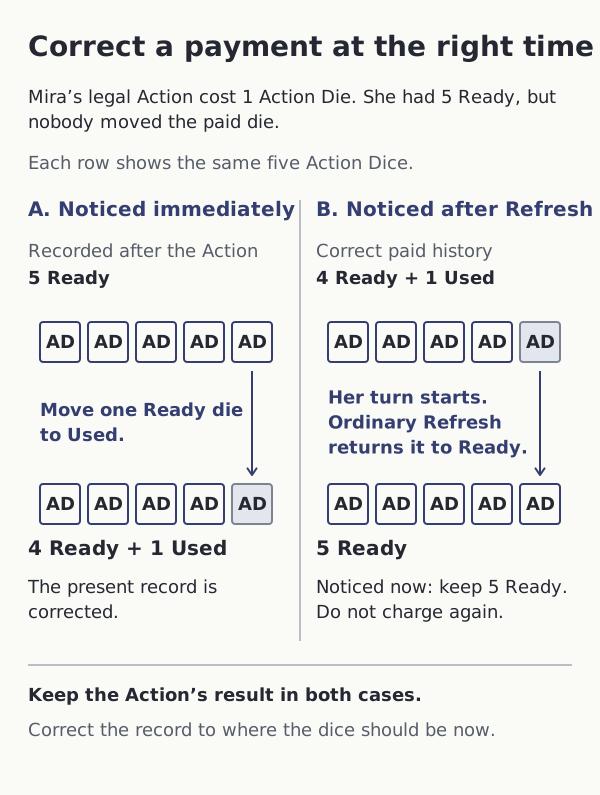
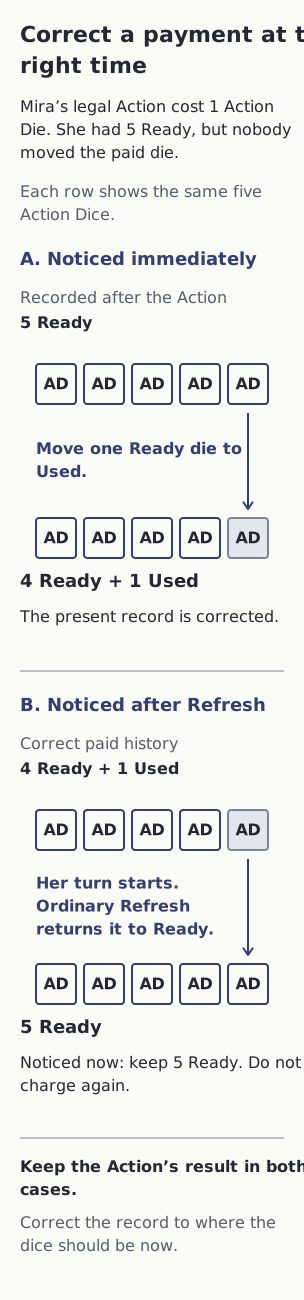
A payment was missed. Mira had five Ready AD and could afford her one-AD Action, but nobody moved the paid die. The mistake is noticed immediately. Move one Ready AD to Used: she now has four Ready and one Used. Keep the Action's result. If her next ordinary Refresh has already happened, that die would be Ready again; do not charge another AD now.
A payment was charged twice. Orin had five Ready AD. A two-AD attack accidentally left one Ready and four Used. Correct it to three Ready and two Used, keeping the attack's result. If a later Wound or conversion affected those dice, reconstruct those changes before adjusting the current pools. A refund cannot simply make a Wounded die Ready.

Read the diagram as text
Mira's legal Action cost 1 Action Die. She had five Ready Action Dice, but nobody moved the paid die. Each row shows the same five dice.
- A. The mistake is noticed immediately, before Refresh. The record still shows five Ready Action Dice. Move one Ready Action Die to Used: the corrected record is four Ready and one Used.
- B. The mistake is noticed after Mira's next ordinary scheduled Refresh. Reconstruct the correct paid history: four Ready Action Dice and one Used Action Die. At the start of her turn, that ordinary Refresh would have returned the Used die to Ready. The correct present record is five Ready Action Dice.
- Notice the mistake now in timeline B and keep all five Ready Action Dice. Do not charge the Action again.
Result: Correct the present record. Before Refresh, move one Ready Action Die to Used. After that ordinary Refresh, keep five Ready Action Dice. Keep the Action's result in both cases.
- This example involves one affordable Action and one ordinary scheduled Refresh, with no other changes to these dice.
- The general correction, rewind and urgent-consequence procedures remain with Correcting a Mistake in Being the Guide. Refresh remains with Narateer Dice.
A Skill use was missed. Mira has Melee level 1 and has started two Melee actions this Activation, but marked only one. Correct the record: she has no proactive Melee uses left. If an excess action has already resolved, use the correction procedure for that action. A Clash response is not an extra proactive use; follow Character Skills.
A Wound was missed. Orin's record shows VIT 1, one Ready AD and four Wounded AD. Two further Wounds were not recorded. The facts are clear, so correct him to VIT −1 and five Wounded AD. With Resilience 2, his corrected state is Critical with one Recovery Die. Resolve that state now; do not roll for turns that already passed. See Critical.
End-of-turn harm was missed. Mira's bleeding source should have caused one Wound at her turn's end. It is noticed before the next creature acts. Apply that Wound and its consequences, then continue. If discovered later, reconstruct the missed applications where possible. Keep their sources and timing separate; do not turn them into one new large attack. Use Lingering Harm.
A range was wrong. The Guide confirmed a shot and resolved it, then discovers that the target was beyond Maximum Range. If the whole Exchange can be rewound cleanly and the affected players agree, restore it and establish a legal choice. If later decisions depend on it, preserve the completed result, clarify the current range and apply targeting requirements to the next attack. Take account of the player having relied on the description you confirmed.
A companion's dice record was lost. A hound began with four Ready AD, spent two on an attack and then suffered one Wound. No Refresh followed. Reconstruct one Ready, two Used and one Wounded, at VIT 3. Its handler's dice stay unchanged. If you cannot reconstruct every change, establish a reasonable present companion record with the player. Losing the record does not reset the animal to its fresh profile.
An expiry was missed or disputed. An effect lasted until the start of Mira's turn, but was still applied afterwards. End that source now and keep completed rolls. Follow its rule for any MD holding it. If another source still applies the same Condition, keep that source. When the timing cannot be reconstructed, establish and record its ending point before the next affected action.
Finish with Something to Carry Forward
Leave time to record where everyone is, what they are doing and which consequences remain urgent. If you stop during an unresolved scene, record the current turn, side due next, dice, VIT, uses, movement and effect deadlines needed to resume it. A real-world break does not reset them. Follow Ending Combat when immediate danger has actually ended.
Ask what interested the players and what was difficult to follow. One useful answer can guide your next preparation. Note an NPC they cared about, a question they want answered and a decision waiting for next time. Use Character Development for awards rather than making a new reward system here.
Confirm the next meeting and share a short recap. Prepare the next situation from what the characters changed. You can build a campaign one meaningful session at a time.
Summary
- Agree on the adventure: Hold a Session Zero. Agree on the kind of adventure, boundaries, access needs and practical arrangements. Give each character a reason to work with the group.
- Prepare a situation: Begin with one place, a problem the characters can change and people with clear wants. Prepare useful leads and possible approaches, leaving room for the players' choices.
- Begin with a choice: Describe what the characters can perceive and enough position to act. Clarify the facts an attempt depends on before anyone commits, then ask what they do.
- Choose useful detail: Use the least positional detail that makes the next choice clear. Add a sketch or change Scene Mode when it helps, preserving the established situation.
- Share attention and records: Invite each player to contribute and share the bookkeeping. Keep each creature's dice, VIT, uses, position and effect deadlines together.
- Correct a mistake: Use reliable facts to correct the present record. A clean immediate rewind restores the whole affected resolution with the affected players' agreement. Otherwise, preserve later completed actions and explain and record the resulting state.
- Handle urgent consequences: Resolve the corrected present state through its owning rule and preserve the normal response or rescue opportunity. Do not invent historical Recovery Rolls or an immediate missed Last Gasp.
- Carry play forward: Record what is needed to resume, hear what interested the players and confirm the next meeting. A real-world break does not reset the game state.