
On this page
Set down the burden. Gather strength together.
A Rest gives characters time to recover from Wounds, restore spent uses, and invest in the people beside them. This chapter brings together the Rest procedure, Synergy, and Training Exchange. Character Development still governs advancement costs and requirements.
A quiet shelter, a shared meal, a familiar voice. The road can wait while you find your strength again.
Taking a Rest
A Rest is an uninterrupted eight-hour period of rest, sleep, meditation, maintenance, or recovery. A character does not need to sleep unless their Bloodline or another rule requires it. During a Rest, they may not cast spells, fight, or perform strenuous actions (i.e., spend Action Dice). If interrupted, the Rest must begin again.
End your Trance before starting a Rest and remain out of Trance throughout it. Entering Trance interrupts the Rest.
Follow any specific Bloodline requirements. For example, a Necrokin completes a Rest by remaining inactive for eight uninterrupted hours.
Natural Recovery
Natural recovery occurs through the formal Rest mechanic. You may restore lost Vitality and AD by completing a Rest.
- After completing a Rest, roll all your Wounded AD.
- For each die that ends on a Hit (one dot) or a Critical Hit (two dots):
- Gain +1 VIT.
- Move that die back to your Ready AD Pool unless the healing effect says otherwise.
- A die that ends on a Miss stays Wounded.
With successful Medicine care: You have Advantage on your Wounded AD recovery roll.
A Necrokin uses the special care rules in its Bloodline: nonmagical Medicine cannot aid its Wound recovery, but another character may use Occult instead during a Rest.
Rest recovery is separate from ordinary AD refresh. For Unconscious and Critical Recovery Rolls, Dying, or Last Gasp, follow Death & Recovery.
Recovering Spent Uses
Class Trait Uses
An uninterrupted eight-hour Rest restores all your spent Class trait uses. Keep each trait’s uses separate. Your allowance is in Class Traits. For gaining ranks, see Character Development.
Trance
After completing the ordinary eight-hour Rest, clear your spent Trance-use count. You begin with no prepared MD. An interrupted Rest restores no Trance uses. Follow the normal Rest rules for other recovery.
Your shared Trance allowance is set by Magic.
Other Limited Uses
Abilities that can be used once per Rest become available again after you complete a Rest. Follow the ability’s own requirements when using it.
Synergy
Synergy is a shared party resource created by investing Story Points together. Once created, it belongs to the party. Do not track which characters contributed.
During a Rest, two different players whose characters are resting together may each spend 1 Story Point to add 1 Synergy to the party’s pool. Each exchange costs 2 Story Points altogether. Eligible pairs may repeat this exchange as often as they agree and can afford.
Synergy remains until spent. It does not expire at a Rest, Story Checkpoint, or Story Milestone. See Character Development for Story Points and their other uses.
After the Guide confirms an active Skill Check, but before the checking character commits any dice, another player may offer to spend 1 Synergy. The checking player must agree.
The granting character must be:
- Present and conscious.
- Aware of the attempt.
- Able to communicate with the checking character through words, gestures, or another understood means.
The checking character gains Advantage on that Skill Check. Follow the normal Edge rules: Advantage and Disadvantage cancel, producing a roll without Edge. This does not remove a condition or its other effects.
Only 1 Synergy may be spent on a check. Do not spend it if the check already has another source of Advantage, even if Disadvantage cancels that source. A player cannot grant Synergy to their own character.
Granting Synergy requires no AD, Action, or Skill Check and is separate from Assist. The granting player may describe encouragement, a warning, a familiar signal, or a reminder of shared experience. A brief description is welcome, but no speech, performance, or explanation is required.
Training Exchange
Training Exchange does not require a Rest. If you train during a Rest, the activity must still meet the limits under Taking a Rest.
Any two different players whose characters spend time training together may agree to undertake a Training Exchange. Each player describes what their character teaches the other. Each then chooses one Skill Level or Class Level to increase and must meet all normal prerequisites and development limits for that increase.
For each chosen increase, the other character must already have a Level in that same Skill or Class equal to or higher than the new Level being gained. Both characters must qualify to train the other. A Level gained during the Training Exchange cannot be used to meet this requirement.
If both increases qualify, reduce the SP cost of each by 1 SP, to a minimum of 1 SP. Pay both costs and apply both increases together. If either character cannot complete their chosen increase, neither receives the reduction.
The characters may increase different Skills or Classes. Each Level increase can benefit from only one Training Exchange, and reductions from multiple Training Exchanges do not stack.
Training Exchange cannot reduce the cost of increasing a Core Vital.
Tip: A Training Exchange can involve different Skills or Classes. Each character teaches from expertise they already possess; neither can use the Level they are currently gaining to qualify the other.
Example: Training Exchange
Rika chooses to raise Finesse from SL 2 to SL 3, which normally costs 3 SP. Javi already has Finesse SL 3, so he qualifies to train her.
Javi chooses to raise Occult from SL 4 to SL 5, which normally costs 5 SP. Rika already has Occult SL 5, so she qualifies to train him.
Because each character qualifies to train the other, they complete the Training Exchange together. Rika pays 2 SP for Finesse SL 3, and Javi pays 4 SP for Occult SL 5.
If Rika had only Occult SL 4, the Training Exchange would not qualify. Javi could train Rika, but Rika could not train Javi to the new Level he is gaining, so neither increase would receive the reduction.
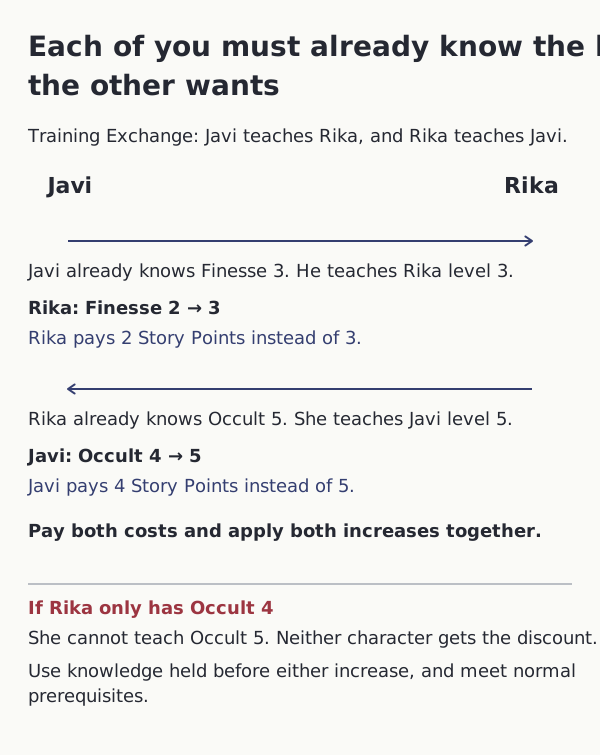
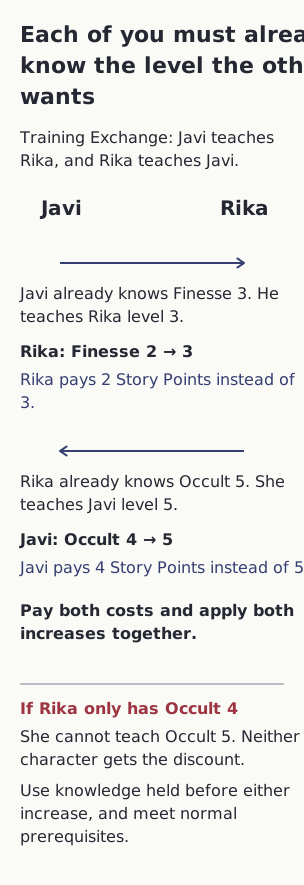

Read the diagram as text
Training Exchange: Rika wants Finesse level 3. Javi wants Occult level 5. They train together and describe what they teach.
- Check knowledge already held before either increase. Javi has Finesse level 3, so he can teach the level Rika wants.
- Rika has Occult level 5, so she can teach the level Javi wants. Both directions qualify.
- Rika’s normal cost of 3 Story Points becomes 2. Javi’s normal cost of 5 becomes 4. Pay both and apply both increases together.
- If Rika has only Occult 4, she cannot teach Occult 5. Neither gets the discount, even though Javi can teach Rika.
Result: Both directions must qualify. A level being gained in this exchange cannot count as knowledge already held.
- The characters belong to two different players. Each increase must meet normal prerequisites and development limits; if either cannot complete their increase, neither gets the reduction.
- Each selected Skill or Class increase receives at most one one-Story-Point reduction, to a minimum cost of one. Reductions do not stack and cannot reduce Core Vital costs.
- Training Exchange does not require Rest. Training during Rest must still obey Rest’s activity limits.
Summary
- Time and sleep: A Rest takes eight uninterrupted hours. You do not need to sleep unless a specific rule requires it.
- Interruptions: Casting, fighting, spending AD, or entering Trance interrupts your Rest. Begin again after an interruption.
- Natural recovery: After a completed Rest, roll your Wounded AD. Each Hit or Critical Hit restores 1 VIT and returns 1 Wounded AD to Ready. Successful Medicine care grants Advantage; follow Bloodline exceptions.
- Spent uses and Trance: A completed Rest restores spent Class trait uses and Trance uses. You begin with no prepared MD.
- Create Synergy: During a shared Rest, two players may each spend 1 Story Point to create 1 shared Synergy. Synergy remains until spent.
- Spend Synergy: Another player may spend 1 Synergy before a checking character commits dice, with the checking player’s agreement. The granting character must be present, conscious, aware, and able to communicate. Apply normal Edge rules.
- Training Exchange: Training Exchange lets two qualifying characters reduce the cost of one Skill or Class increase each by 1 SP, to a minimum of 1 SP. It does not require a Rest or reduce Core Vital costs.