
On this page
Two lives. One road.
A Companion is a willing, trained beast that works with you. It can be any suitable creature from the Bestiary. It has its own body, Skills and Action Dice. It can follow a familiar task, act and defend itself even when you are elsewhere.
Trust turns a familiar signal into a shared purpose.
One Partner
With Beastcraft level 1 or higher, you can bond with one creature whose Bestiary entry says it can be a companion. Any Class can do this, including at character creation. You can have one bonded companion at a time.
The creature's Bestiary entry supplies its game abilities: its Vitals, Skills, natural attacks and traits. Choosing a Companion explains how a creature becomes yours.
Choosing a Companion
First a friend. Then a partner.
Beastcraft is patience, not magic. You can't walk up to a wild boar and make it yours. A creature must trust you before it will work with you.
- Find a creature that can be a companion. Its Bestiary entry says Companion: Yes. Swarms, venomous creatures, sharks and the very largest beasts can't be companions.
- Make it friendly. A creature you mean to bond with must already be friendly towards you. A farm dog or a mule usually is. A wild creature has to be won over in play: feeding it, rescuing it, sharing its territory or raising it from young. The Guide decides from the story whether it is friendly, and may call for Beastcraft checks along the way when the outcome is uncertain.
- Bond with it. Spend eight hours working together, then make a Beastcraft check against the Difficulty set by its Temperament:
| Temperament | Difficulty |
|---|---|
| Tame | Routine (DR 0) |
| Wary | Challenging (DR 1) |
| Wild | Heroic (DR 3) |
| Fierce | Epic (DR 5) |
The story decides Advantage or Disadvantage. You have Advantage if you raised the creature from young, or it was already trained to work with people. You have Disadvantage if it was caught wild as an adult, or it is hurt or frightened.
On a success, the bond forms. On a failure, the creature stays friendly but is not yet ready; you can try again after another day together. Bonding time does not count as a Rest.
Buying a trained animal. A trained Tame or Wary animal costs 50 Dritch where one is for sale. It is already friendly and trained, so your bonding check has Advantage. Wild and Fierce creatures can't be bought trained; they must be won over.
At character creation, choose a Tame or Wary creature that can be a companion, pay the 50 Dritch from your starting money, and include the completed bond in your background. No check is needed. Choose a name and the animal with the Guide.
Its Own Dice and Skills
Your companion's Maximum Vitality gives it its own AD. Its Bestiary entry gives its Vitality; a Hound, for example, has Vitality 3 and begins uninjured with three Ready AD. Track its Ready, Used and Wounded dice separately from yours.
The companion pays for its Actions, Boost, Exchange Responses and Reactions from its own Ready AD. Use its own Skill level for Boost, Readiness and proactive Skill uses. Its body, position, awareness, equipment and Conditions apply to its attempts. Your Skills and Conditions do not become its Skills and Conditions.
Use the normal Action and Skill Check procedures. For example, a companion with Melee level 1 may initiate two Melee actions during its Activation and Boost each check by up to 1 AD, if it can afford them. A Bite with base cost 1 AD and Boost 1 leaves an uninjured hound with two Ready AD for another action or a response.
Taking Its Turn
In the same fight, your companion takes one Activation each Round, immediately after yours. It keeps this place if you cannot act, leave the fight or collapse. It refreshes its own Used AD at the start of its turn, following the normal rules for Refresh.
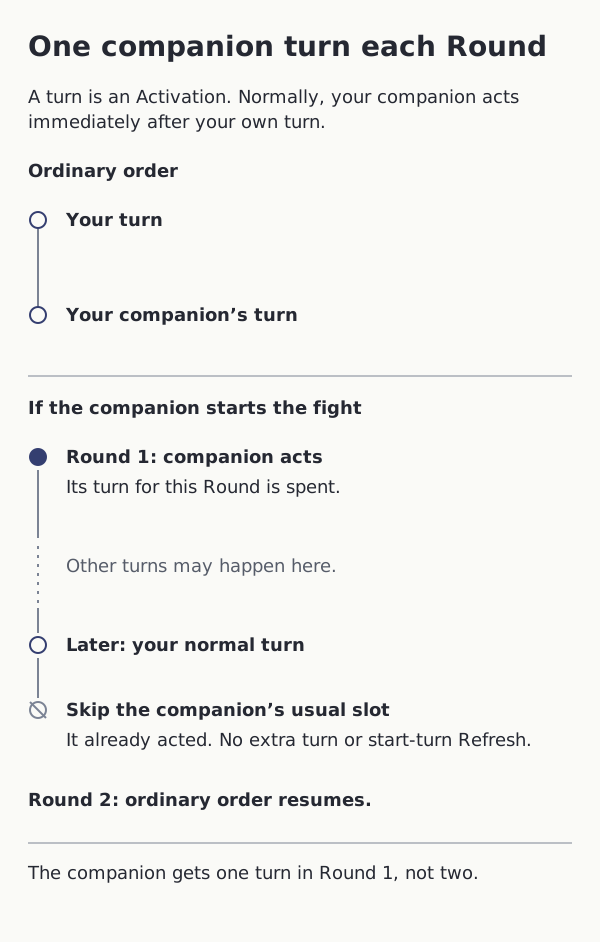
If your companion starts the fight, its opening Activation uses its turn for that Round. Skip its turn after yours that Round; from the next Round it follows you normally. See Companions and Servants for arrivals and other timing questions.
If it enters a fight on its own, give it a place in the fight's turn order. If you later join it, keep that order. When fights meet, carry forward whether each creature has already acted in the current Round. Neither creature gains another Activation, Refresh or movement allowance by leaving, returning or changing who directs the animal.
Outside combat, resolve its tasks at the pace the situation needs. Changing Scene Mode does not create extra time or restore spent resources.

Read the diagram as text
A turn is an Activation. In the same encounter, your companion normally takes one turn immediately after yours. Starting the fight uses its turn for that Round.
- Normally, take your scheduled turn, then your companion immediately takes its one turn for that Round.
- If the companion starts the fight, its opening turn uses its Round 1 turn.
- Other combatants may take turns before your scheduled turn. Later, when your normal turn comes, take it normally.
- Skip the companion’s usual slot after you in Round 1: it has already acted and gets no additional turn or start-turn Refresh.
- From Round 2, your companion again takes its turn immediately after yours.
Result: The companion does not act twice in Round 1, and its opening does not grant you an immediate extra turn.
- It refreshes its own Used Action Dice at the start of its own turn under normal Refresh rules.
- Its place continues if you cannot act, leave or collapse.
- If it already has a separate encounter order when you join, keep that established order.
- When scenes meet, carry actual acted/not-acted state. Leaving, returning or changing handler grants no extra turn, Refresh or movement allowance.
Giving Instructions
You play your companion using what it can perceive and understand. The Guide decides whether an instruction is understood and physically possible. Its willingness to help does not give it human reasoning or require it to obey a suicidal command.
Give it one simple task at a time: follow you, stay in a place, fetch a familiar object, follow a scent, guard a person or place, or attack a creature it can identify. Brief familiar words or signals are Trivial Actions: 0 AD, with no check. The animal must be able to see or hear the signal and recognise what it refers to.
A task continues until it is completed, replaced or no longer possible. Immediate danger may pause it. Losing contact does not cancel it. It can choose ordinary movement and actions needed for that task, paying their normal costs. Giving an instruction grants no immediate extra action or turn.
- Stay: remain at the named place. It can still defend itself or move away from immediate danger.
- Guard: remain with the named person or place, warn of danger it notices and respond to an obvious threat. It does not recognise secret enemies or disguised intentions automatically.
- Attack: pursue and attack the named creature while it can identify and reach it, without following an obviously suicidal pursuit. If that creature can no longer fight or is lost from its senses, the task ends; it does not automatically select another target.
- Fetch or follow a trail: continue the understood task beyond contact. Make the animal's own checks when the outcome is uncertain.
When a task ends, it stays nearby if safe, or returns to you if it knows a safe route. Immediate danger lets it defend itself, seek safety or protect someone it recognises as its charge. Once safe, it resumes a task that still makes sense. The Guide resolves genuine uncertainty about its behaviour; familiar harmless instructions do not need repeated obedience checks.
If understanding or willingness is uncertain, the Guide states the possible result and Difficulty before you attempt a Beastcraft check, paying its normal 1 AD and any Boost. Success gets an understandable, possible instruction across; it does not grant the animal a new Skill or make an impossible task possible. Failure leaves its existing task in place unless circumstances have already ended it. The animal still pays for its own attempt afterwards.
Staying in Contact
Ordinary instructions depend on signals the animal can actually perceive. A familiar call can reach beyond the range of a Class trait. A wall, loud noise or lost line of sight may prevent a particular signal.
The bond does not share senses. When a scout returns, it communicates through trained calls, signals and behaviour. You do not automatically learn everything the player saw while resolving its task. You cannot give it a fresh tactical instruction using information it has not received.
If you are Unconscious, absent or unable to communicate, it continues under its task and the behaviour above. It can act and defend itself without spending your dice. Its own Continuation Checks and Conditions still apply.
Movement and Physical Tasks
The animal uses its own Base Movement and chooses one normal movement mode during its Activation. It pays for its own Run or Sprint. A creature with Flight flies using the same movement modes and costs in three dimensions. Use Distance & Range to convert metres into Zones or Spaces.
A companion can attempt the ordinary tasks its body suits, as the Guide confirms: a hound can follow tracks and carry an object in its mouth; a hawk can perch, fly and carry one Bulk-0 object in its claws. It can carry a rider only if its entry has Carries a Rider.
Reactions and Responses
An aware companion can choose and pay for its legal Exchange Response even when you cannot see or direct it. Against Melee, Full Guard uses its Melee; against Ranged, Full Guard uses its Acrobatics. Its natural attack can make a Melee Clash when it can reach. Without a legal affordable response, it makes No Response.
It can take ordinary Reactions when their written Triggers occur. A standing instruction creates no extra Reaction or Opportunity Attack. Your Conditions restrict your own participation; its Conditions restrict its participation.
Working Together
Either partner can Assist the other when physically present and able to make a real contribution. The assisting creature spends and rolls its own AD. This is the ordinary Assist procedure, not automatic Advantage. The companion is not another player for Synergy.
A Class trait that names your companion belongs to you: spend your use, not an animal use. For one trait per Event, count your traits used on either partner together. The companion gains no separate Class traits or uses from the bond.
To use a trait on its behalf, you must be Active, aware of the triggering situation and able to communicate with it within 6m per Beastcraft level. It must be Active and able to carry out the effect. Check these requirements when you declare the trait. Losing contact afterwards does not cancel a declared bonus; a later trait needs its own valid signal.
When a trait requires a boosted companion check, the companion pays the Boost from its own AD, within its own Skill limit. Pay any additional AD cost from the creature named in the trait. Your ordinary traits, Bloodline abilities and equipment affect your own actions unless they name the companion.
Vitality and Wounds
Apply Wounds to the creature struck, using its own dice. A Wound to the companion reduces its Vitality and moves one of its unwounded dice to Wounded, taking Ready dice before Used dice. Your dice do not change.
Use its own Resilience for Continuation and Recovery Rolls. At 0 Vitality or below, follow Death & Recovery. Its scheduled turn still occurs for recovery even if you cannot act. Healing and Rest restore its own Vitality and Wounded AD under the normal rules. Its Wounded dice do not return through Refresh.
Training and Changing Companions
A companion's Vitals and Skill ratings come from its Bestiary entry and stay fixed. Gaining your own Skill or Class levels does not increase them. Practising together can teach new familiar tasks within the animal's abilities; it does not grant extra dice, Skill levels or trait uses. The animal has no separate Story Point progression through this bond.
If your Beastcraft falls to level 0, the animal retains its Skills, familiar tasks and relationship with you. You cannot form a new bond or use traits through that bond until Beastcraft is restored.
Release the old bond before forming another. A new bond follows Choosing a Companion again; a bought trained animal still costs 50 Dritch. The released animal leaves your player-controlled companion role and follows the Guide's ordinary creature handling. Releasing it does not leave a second commanded combatant behind. Changing handler or companion restores no spent trait uses or dice and heals no injuries. An animal retains its actual state rather than resetting to a fresh profile.
Summary
- Form a bond: Any Class with Beastcraft level 1 or higher can bond with one companion at a time, chosen from the Bestiary, including at character creation.
- Friend first: The creature must already be friendly. Then spend eight hours together and make a Beastcraft check against its Temperament: Tame DR 0, Wary DR 1, Wild DR 3, Fierce DR 5. Untamable creatures can't bond. A trained Tame or Wary animal costs 50 Dritch and gives Advantage. Bonding is not a Rest.
- Separate resources: Your companion has its own Skills, Vitality and AD. It pays its own costs and uses its own Skill limits.
- Turn order: In the same fight, it takes one Activation immediately after yours. A companion with an established turn order keeps that place if you join later.
- Give a task: Give one simple task at a time. Familiar signals cost 0 AD; the animal must perceive and understand them. Uncertain instructions use a paid Beastcraft check.
- Contact and senses: An understood task can continue beyond contact. The bond shares no senses; a returning scout communicates through trained calls, signals and behaviour.
- Physical tasks: Use its entry's movement, natural attacks and traits. It can attempt tasks suited to its body and training. It carries a rider only if its entry says so.
- Responses and Reactions: Use ordinary Assist and legal Exchange Responses and Reactions, paid from the animal's own AD.
- Use your traits: Your traits spend your uses. Both partners must be Active; you must be aware and able to communicate within 6m per Beastcraft level. The companion pays required Boost from its own AD.
- Injury and recovery: Track its Wounds and recovery separately. Use its Resilience and Death & Recovery; Refresh never restores Wounded AD.
- Training and new partners: Its entry's ratings stay fixed. Training can teach familiar tasks. Changing companions requires a new eight-hour bond, refreshes no spent resources and heals no injuries.